Human Intelligence
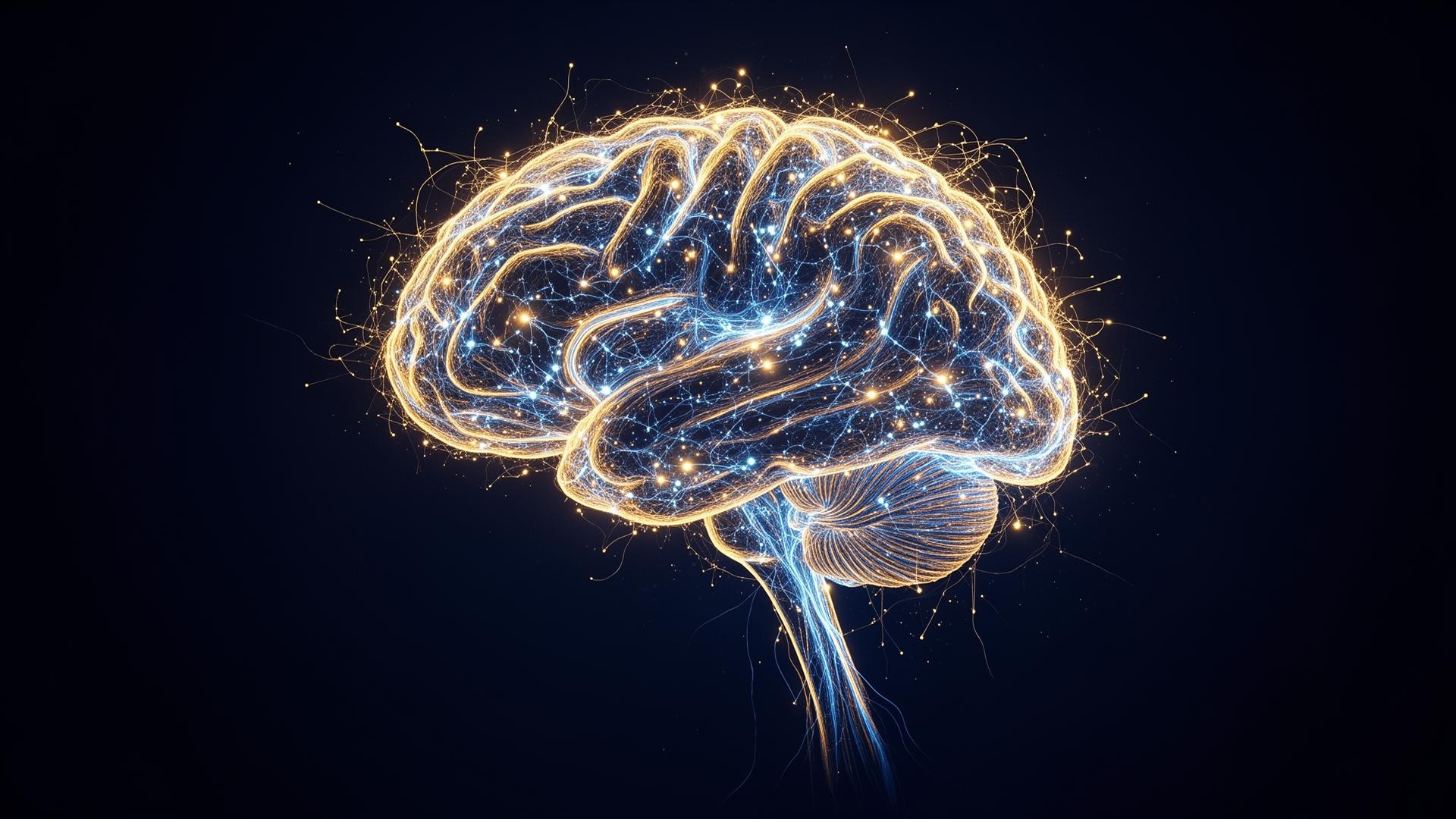
Human intelligence is the most sophisticated information-processing system we know of - roughly 86 billion neurons forming trillions of synaptic connections, operating on a 20-watt power budget, capable of language, abstraction, creativity, and self-awareness.
Key takeaways
- The brain is a prediction machine that continuously updates internal models of the world.
- Memory is reconstructive, not playback - every recall subtly rewrites the trace.
- Intelligence is multidimensional: fluid reasoning, crystallized knowledge, social cognition, and embodied skill.
- Consciousness remains the hardest open problem in science.
What you'll learn
A grounded tour of how the brain perceives, reasons, remembers, and creates - drawing on cognitive neuroscience, psychology, and the modern understanding of consciousness.
Explore the topics
Deep explainers across the field, from foundational concepts to frontier research.
The Neuron and the Brain
From action potentials to cortical circuits - the biological substrate of thought.
Perception and Attention
How the brain constructs reality from noisy sensory input.
Memory Systems
Working, episodic, semantic, procedural - the architecture of remembering.
Reasoning and Decision-Making
Dual-process theory, heuristics, and bounded rationality.
Language and Symbolic Thought
How humans evolved to compose meaning from arbitrary symbols.
Consciousness
Global workspace, integrated information, and the hard problem.
Intelligence and IQ
What psychometric intelligence measures - and what it misses.
Embodied Cognition
Why thinking is shaped by the body and environment.
Frequently asked questions
What is human intelligence?
+
Human intelligence is the capacity to learn, reason, plan, solve novel problems, and adapt - implemented in a biological neural network shaped by evolution, development, and culture.
How many neurons does the human brain have?
+
Roughly 86 billion neurons, plus a similar number of glial cells, forming an estimated 100–500 trillion synaptic connections.
Is IQ a complete measure of intelligence?
+
No. IQ captures certain reasoning and processing abilities but misses creativity, emotional intelligence, embodied skill, and domain expertise.
What is the hard problem of consciousness?
+
The question of why physical processes in the brain are accompanied by subjective experience - first articulated by philosopher David Chalmers.
How does human cognition differ from AI?
+
Humans learn continuously from sparse data, are embodied, have intrinsic motivation, and reason causally - capabilities current AI only partially replicates.
Glossary
- Neuron
- Electrically excitable cell that processes and transmits information via electrochemical signals.
- Synapse
- Junction between two neurons where signals are passed chemically or electrically.
- Cortex
- Outer layer of the brain responsible for higher cognitive functions.
- Working Memory
- Short-term system for holding and manipulating information.
- Plasticity
- The brain's capacity to reorganize itself by forming new connections throughout life.
- Qualia
- The subjective, experiential qualities of conscious states.
Read full definition
Read full definition
Read full definition
Read full definition
Read full definition
Read full definition
Tools for a sharper mind
Books, journals and gear frequently cited across cognitive science reading lists. As an Amazon Associate BRAINMATTER earns from qualifying purchases at no extra cost to you.
Sponsor this work
BRAINMATTER is independent and reader-supported. Everything here stays free, ad-light, and open to everyone. A one-time sponsorship covers research time, editorial review, and hosting so we can keep publishing without paywalls.
Further reading & sources
Explore the BRAINMATTER pillars
Authoritative cornerstone hubs across human intelligence, AI, neurotechnology, and the brain economy. Each link goes to a pillar with long-form explainers, sources, and FAQs.
The Future of Human Intelligence
Flagship pillar on cognitive neuroscience, neuroplasticity, and the next 25 years of the human mind.
Human intelligence · Neuroplasticity · Brain capital
Artificial Intelligence & NeuroAI
Foundation models, transformers, multimodal systems, and brain-inspired AI architectures.
AI · NeuroAI · Foundation models
Artificial General Intelligence (AGI)
Definitions, benchmarks, timelines, and the open scientific problems on the road to AGI.
AGI · Superintelligence · Scaling laws
Neurotechnology & Brain–Computer Interfaces
BCIs, neural implants, neuromodulation, and the engineering of human cognition.
Neurotechnology · BCI · Neural implants
Human–AI Collaboration & Cognitive Enhancement
How humans and intelligent systems augment each other's reasoning, creativity, and decision-making.
Human-AI collaboration · Cognitive enhancement
Neurodivergence & Brain Health
Autism, ADHD, dyslexia, and the neuroscience of cognitive diversity and lifelong brain health.
Neurodivergence · Brain health · Neurodiversity
AI Ethics, Safety & Alignment
Bias, privacy, misinformation, AI safety, and governance of intelligent systems.
AI ethics · Alignment · Governance
Future of Humanity & the Brain Economy
Long-horizon scenarios for the brain economy, post-AGI society, and civilizational risk.
Brain economy · Post-AGI · Long-termism
Intelligence Index — Human vs Machine
The definitive comparison of biological and artificial cognition across substrate, scale, and reasoning.
Intelligence index · Benchmarks · Comparative cognition
Frontier AI & Neuroscience Labs
Deep profiles of the research organizations defining the next era of intelligence.
OpenAI · Anthropic · DeepMind · Neuralink
Continue exploring
Artificial Intelligence
How modern AI systems learn, reason, and generate - from neural networks to large language models.
Neurotechnology
Brain-computer interfaces, neural implants, and the convergence of biology and silicon.
Intelligence Index
A side-by-side comparison of human cognition, LLMs, and emerging AGI architectures.