
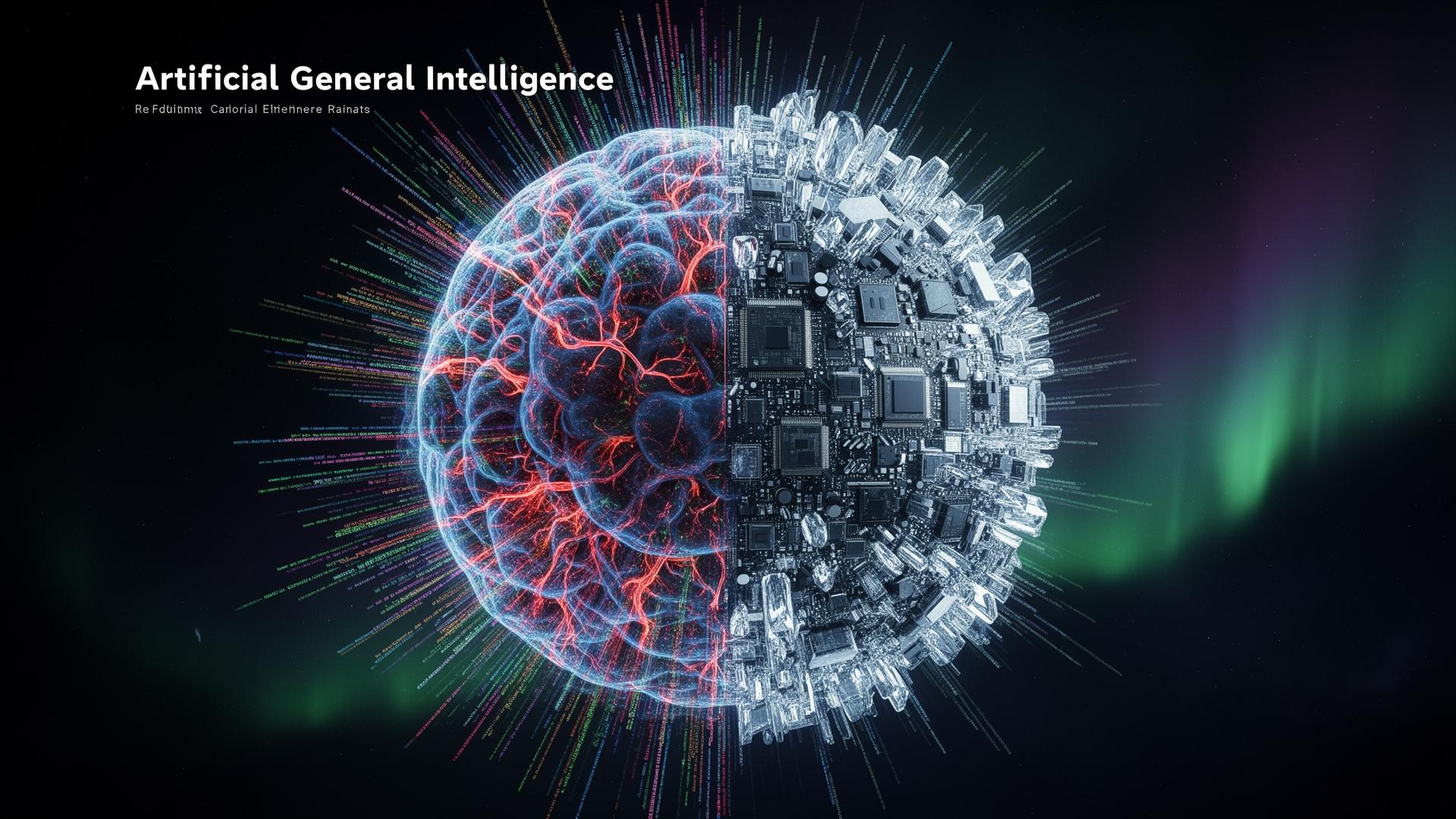
Artificial General Intelligence
Artificial General Intelligence (AGI) refers to systems capable of human-level reasoning, learning, and adaptation across essentially any cognitive task. Whether - and when - AGI will be built is the most consequential open question in technology.
Key takeaways
- There is no consensus definition of AGI, but most center on broad task generality and self-directed learning.
- Forecasts from leading labs and researchers cluster between 2030 and 2050 - with wide uncertainty.
- Alignment - ensuring AGI pursues intended goals - is widely viewed as the core technical risk.
- AGI would reshape labor, science, governance, and possibly the trajectory of civilization.
What you'll learn
A balanced examination of AGI: definitions, timelines, technical paths, alignment, governance, and the civilization-scale stakes.
Explore the topics
Deep explainers across the field, from foundational concepts to frontier research.
Defining AGI
Why the term resists a single definition.
Timeline Predictions
What top researchers and labs forecast - and why estimates differ.
Superintelligence
What comes after human-level - and why it matters.
Consciousness Debates
Could AGI be conscious? Would it matter?
AI Alignment
The technical challenge of building AGI that pursues human-compatible goals.
Existential Risks
Scenarios where advanced AI causes catastrophic harm.
Economic Impact
Labor displacement, productivity surge, and the future of work.
Societal Transformation
How AGI could reshape education, science, and governance.
AGI Governance
International coordination, treaties, and oversight regimes.
Frequently asked questions
What is AGI?
+
Artificial General Intelligence is a hypothetical AI system that matches or exceeds human cognitive ability across virtually any domain - reasoning, learning, planning, and creative problem-solving.
When will AGI be built?
+
Estimates vary widely. Surveys of AI researchers cluster around 2040–2060 for a 50% probability, but leading lab CEOs have suggested timelines as short as 3–10 years.
Are current LLMs AGI?
+
Most researchers say no. Frontier LLMs show striking general capability but still struggle with consistent reasoning, novel problem-solving, and long-horizon planning.
What is the alignment problem?
+
The challenge of ensuring an AGI system reliably pursues the goals its designers intend, even as it becomes more capable than its overseers.
Is AGI dangerous?
+
Many serious researchers consider misaligned AGI a major risk. Risk levels depend on the path to AGI, governance frameworks, and the success of alignment research.
Glossary
- AGI
- Artificial General Intelligence - broad, human-level machine cognition.
- ASI
- Artificial Superintelligence - intelligence substantially exceeding human ability.
- Alignment
- Research aimed at making AI systems pursue intended goals safely.
- Mesa-optimization
- When a learned model internally develops its own optimization process.
- Capabilities Overhang
- Latent capabilities that emerge unexpectedly as models scale.
- Foom
- Hypothetical rapid, recursive self-improvement leading to superintelligence.
Read full definition
Read full definition
Read full definition
AGI reading list
Foundational and frontier books on general intelligence. As an Amazon Associate BRAINMATTER earns from qualifying purchases at no extra cost to you.
Sponsor this work
BRAINMATTER is independent and reader-supported. Everything here stays free, ad-light, and open to everyone. A one-time sponsorship covers research time, editorial review, and hosting so we can keep publishing without paywalls.
Further reading & sources
Explore the BRAINMATTER pillars
Authoritative cornerstone hubs across human intelligence, AI, neurotechnology, and the brain economy. Each link goes to a pillar with long-form explainers, sources, and FAQs.
The Future of Human Intelligence
Flagship pillar on cognitive neuroscience, neuroplasticity, and the next 25 years of the human mind.
Human intelligence · Neuroplasticity · Brain capital
Human Intelligence & Cognitive Neuroscience
How the brain learns, remembers, reasons, and feels — from working memory to consciousness.
Cognitive neuroscience · Memory · Consciousness
Artificial Intelligence & NeuroAI
Foundation models, transformers, multimodal systems, and brain-inspired AI architectures.
AI · NeuroAI · Foundation models
Neurotechnology & Brain–Computer Interfaces
BCIs, neural implants, neuromodulation, and the engineering of human cognition.
Neurotechnology · BCI · Neural implants
Human–AI Collaboration & Cognitive Enhancement
How humans and intelligent systems augment each other's reasoning, creativity, and decision-making.
Human-AI collaboration · Cognitive enhancement
Neurodivergence & Brain Health
Autism, ADHD, dyslexia, and the neuroscience of cognitive diversity and lifelong brain health.
Neurodivergence · Brain health · Neurodiversity
AI Ethics, Safety & Alignment
Bias, privacy, misinformation, AI safety, and governance of intelligent systems.
AI ethics · Alignment · Governance
Future of Humanity & the Brain Economy
Long-horizon scenarios for the brain economy, post-AGI society, and civilizational risk.
Brain economy · Post-AGI · Long-termism
Intelligence Index — Human vs Machine
The definitive comparison of biological and artificial cognition across substrate, scale, and reasoning.
Intelligence index · Benchmarks · Comparative cognition
Frontier AI & Neuroscience Labs
Deep profiles of the research organizations defining the next era of intelligence.
OpenAI · Anthropic · DeepMind · Neuralink
Continue exploring
Ethics, Risks & Society
Bias, privacy, safety, governance - the responsibilities that come with intelligent systems.
Future of Humanity
Long-term scenarios for civilization, cognition, and what it means to be human in an AI era.
Artificial Intelligence
How modern AI systems learn, reason, and generate - from neural networks to large language models.