This site demonstrates one possible use of this domain. For acquisition, partnership, or investment inquiries, please use our contact link. (brainmatter.com)
BRAINMATTER - Intelligence Beyond Limits
The Future of Intelligence

Explaining intelligence
itself.

BRAINMATTER is the definitive destination for understanding human intelligence, artificial intelligence, AGI, NeuroAI, cognitive neuroscience, neurotechnology, brain-computer interfaces, brain health, cognitive enhancement, and human-AI collaboration in the emerging brain economy.

Flagship Pillar

The Future of Human Intelligence

Most neuroscience sites focus on disease. Most AI sites focus on software. BRAINMATTER owns the space in between — the science of the mind that learns, remembers, creates, and increasingly collaborates with intelligent machines.

  • Neuroplasticity & lifelong learning
  • Memory, creativity, consciousness
  • Cognitive enhancement evidence
  • Human + AI cognitive augmentation
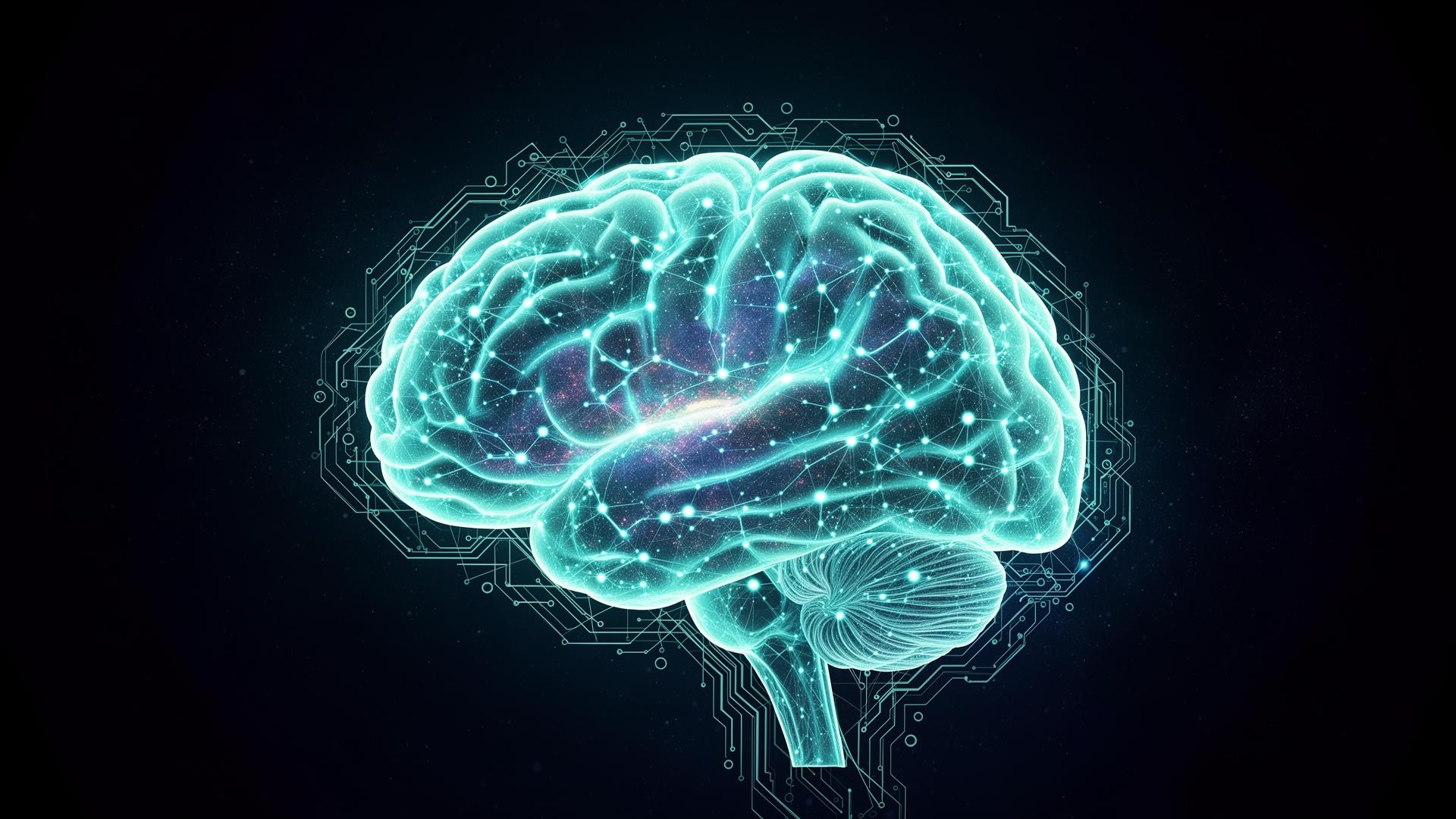
The future of human intelligence — a luminous brain rendered as a cosmic neural constellation.
Comparative Cognition

Human, machine, and the in-between

How biological and artificial systems differ - in substrate, scale, and reasoning.

Human

  • ~86 billion neurons, ~100 trillion synapses
  • Embodied, sensorimotor cognition
  • ~20 watt metabolic power budget
  • Continuous, lifelong learning
  • Episodic + semantic long-term memory
  • Emotion, motivation, and homeostatic drives
  • Social cognition and theory of mind
  • Slow serial reasoning, massive parallel perception

LLMs

  • Hundreds of billions to trillions of parameters
  • Next-token prediction over learned distributions
  • Megawatt-scale training on GPU/TPU clusters
  • Fixed weights after training; no online learning
  • Context-window memory (tens to millions of tokens)
  • Transformer attention over tokenized inputs
  • RLHF and constitutional fine-tuning for alignment
  • Strong language and code; brittle long-horizon planning

AGI (concept)

  • Domain-general reasoning across novel tasks
  • Robust transfer and few-shot generalization
  • Recursive self-improvement (hypothesized)
  • Persistent world models and causal inference
  • Long-horizon planning with tool and agent use
  • Stable goals and value alignment under distribution shift
  • Grounded multimodal perception and action
  • Open scientific problem - no working system exists
Trajectory

A timeline of intelligence

From today's foundation models to long-horizon scenarios for AGI and beyond.

  1. Today

    Foundation Models

    LLMs and multimodal systems reshape work, research, and creativity.

    01
  2. 2026–2028

    Agentic AI

    Autonomous agents plan, reason, and act across digital and physical systems.

    02
  3. 2030s

    Proto-AGI

    Systems demonstrating broad transfer learning and scientific discovery.

    03
  4. 2040s+

    AGI & Beyond

    General reasoning meets human collaboration - and raises civilization-scale questions.

    04
The Frontier

Inside the labs building intelligence

In-depth profiles of the research organizations defining the next era of AI.

Long Form

Featured deep dives

Authoritative, source-cited essays across every cluster - from the hard problem of consciousness to scaling laws.

Foundations · 9 min

Defining AGI: Why the Term Resists a Single Meaning

Artificial General Intelligence is the most consequential idea in modern technology - and the most contested. Researchers disagree not only on when AGI will arrive, but on what it actually is.

Subjective Experience · 9 min

Consciousness: The Hardest Problem

Why physical brain processes are accompanied by subjective experience remains the deepest open question in science. Several rigorous theories compete; none is established.

Architecture · 11 min

The Transformer Architecture

Introduced by Vaswani et al. in the 2017 paper 'Attention Is All You Need,' the transformer is the architectural foundation of nearly every frontier AI system today - GPT, Claude, Gemini, Llama, AlphaFold, and Stable Diffusion's text encoder all rely on it.

Foundations · 16 min

Brain-Computer Interfaces: An Overview

A brain-computer interface (BCI) is a system that translates measured neural activity into commands for an external device, and, increasingly, writes structured information back into the nervous system. After five decades as a research curiosity, BCIs are now a regulated medical-device category, with multiple human implants in active FDA trials and the first 1,000-channel-class systems in clinical use.

Macroeconomics · 11 min

The Post-AGI Economy

If cognitive labor becomes cheap and abundant, the foundations of modern economies - wages, property, comparative advantage, the social contract - strain in ways economists are just beginning to model.

The Network

Every cornerstone, one click away

The BRAINMATTER pillars — interlinked hubs across human intelligence, AI, AGI, neurotechnology, and the brain economy.

Cornerstone pillars

Who writes BRAINMATTER

Credentialed editors & a named science review board

Every BRAINMATTER explainer is overseen by a named editor and reviewed for scientific accuracy against peer-reviewed literature (NIH, PubMed, Nature, arXiv) by domain experts before publication.

Editor-in-Chief

Dr. Ira S. Pastor

Founder, BrainMatter Editorial

Founder of BrainMatter, with two decades of work at the intersection of biotechnology, longevity science, and intelligence research. Oversees editorial standards and source review across every BrainMatter article.

  • Biotechnology
  • Longevity
  • Intelligence research
  • Editorial oversight
Reviewer - Cognitive Neuroscience

Dr. Maya Ellingham, PhD

PhD Cognitive Neuroscience; postdoctoral training in functional connectomics

Reviews BrainMatter coverage of brain structure, functional networks, and the neural basis of cognition. Verifies claims against PubMed, NeuroImage, and Nature Neuroscience.

  • Functional connectomics
  • fMRI methodology
  • Working memory
  • Attention networks
Reviewer - Machine Learning

Dr. Rohan Vasquez, PhD

PhD Computer Science (Machine Learning); former research scientist at a frontier AI lab

Reviews BrainMatter coverage of deep learning, large language models, and evaluation benchmarks. Verifies technical claims against arXiv preprints and NeurIPS / ICML proceedings.

  • Large language models
  • Transformer architectures
  • Benchmark evaluation
  • Reinforcement learning
Reviewer - Clinical Neurology

Dr. Aiko Tanaka, MD PhD

MD PhD; board-certified neurologist; clinical researcher in neuromodulation

Reviews BrainMatter coverage of brain-computer interfaces, deep brain stimulation, and clinical neurotechnology. Verifies clinical claims against NEJM, JAMA Neurology, and FDA filings.

  • Brain-computer interfaces
  • Deep brain stimulation
  • Clinical trials
  • Neuromodulation
Reviewer - AI Safety & Alignment

Dr. Samuel Okafor, PhD

PhD; researcher in technical AI safety and alignment theory

Reviews BrainMatter coverage of AGI timelines, alignment, interpretability, and governance. Verifies claims against MIRI, Alignment Forum, and peer-reviewed safety literature.

  • AI alignment
  • Interpretability
  • AGI risk analysis
  • AI governance
Reviewer - Neurodivergence & Cognitive Psychology

Dr. Priya Raman, PhD

PhD Cognitive Psychology; clinical research in ADHD, autism, and adult cognitive variation

Reviews BrainMatter coverage of neurodivergence, augmented cognition, and the cognitive psychology of attention, memory, and executive function. Verifies claims against NIMH, DSM-5-TR, and peer-reviewed cognitive science journals.

  • Neurodivergence
  • ADHD research
  • Executive function
  • Cognitive psychology
Reviewer - Computational Neuroscience

Dr. Lukas Berger, PhD

PhD Computational Neuroscience; specializes in biologically-plausible neural models

Reviews BrainMatter coverage at the boundary of artificial and biological neural systems - predictive coding, spiking networks, neuromorphic computing. Verifies claims against PLOS Comp Bio, Neural Computation, and Nature Comp Sci.

  • Predictive coding
  • Spiking neural networks
  • Neuromorphic computing
  • Computational models
Frequently Asked

Questions about intelligence

Concise, sourced answers to the most-asked questions on human intelligence, AI, AGI, NeuroAI, brain-computer interfaces, brain health, and the brain economy.

What is the difference between human intelligence and artificial intelligence?

Human intelligence is biological, embodied, energy-efficient (~20 watts), and learns continuously across a lifetime through episodic and semantic memory. Artificial intelligence — today dominated by large language models — runs on GPU clusters, learns once from massive datasets, and predicts the next token in a sequence. Humans are stronger at causal reasoning, social cognition, and long-horizon planning; AI is stronger at recall, pattern matching, and parallel language and code generation.

Compare in the Intelligence Index

What is NeuroAI and why does it matter?

NeuroAI is the research frontier that uses neuroscience to build better AI and uses AI to better understand the brain. It includes biologically-plausible neural networks, predictive coding, neuromorphic computing, and AI models of cortical circuits. NeuroAI matters because the brain remains the only known example of general intelligence — and it does so on a fraction of the energy of any current AI system.

Explore AI explainers

When will we have AGI (artificial general intelligence)?

There is no scientific consensus. Surveyed AI researchers' median estimates have shifted from the 2060s to the 2030s–2040s as scaling and agentic systems have advanced, while critics argue that current architectures lack causal reasoning, persistent world models, and grounded perception required for general intelligence. AGI remains an open scientific problem with no working system in existence.

Read the AGI pillar

How does a brain-computer interface (BCI) work?

A BCI records electrical activity from neurons — either invasively, via implanted electrode arrays (Neuralink, Synchron, Blackrock), or non-invasively, via EEG and fNIRS. Machine-learning decoders translate those neural signals into intended actions: cursor movement, speech, robotic control. Modern clinical BCIs have restored communication to people with paralysis and ALS, and remain the most direct technology connecting the brain to digital systems.

Inside the neurotech pillar

What is the brain economy?

The brain economy is the emerging global economic sector built on cognitive capital — neurotechnology, AI, brain health, education, mental health, and the productivity of knowledge workers. The OECD and WEF have begun tracking brain capital as a leading indicator of national competitiveness, treating cognition itself as critical infrastructure for the 21st century.

Inside the Human Intelligence Project

What is cognitive enhancement, and does it actually work?

Cognitive enhancement covers any intervention that measurably improves attention, memory, or executive function — from sleep, aerobic exercise, and meditation (strong evidence) to nootropics, transcranial stimulation, and pharmaceuticals (mixed evidence). The most robust gains in healthy adults come from cardiovascular exercise, deep sleep, and deliberate practice; pharmacological gains tend to be small, narrow, or restricted to people with diagnosed deficits.

Human intelligence pillar

How can I keep my brain healthy as I age?

The peer-reviewed consensus from NIH, NIA, and Lancet Commission reports converges on a small set of high-leverage habits: regular aerobic and resistance exercise, 7–9 hours of consistent sleep, a Mediterranean-style diet, blood pressure and metabolic control, lifelong learning, social connection, and hearing-loss management. These reduce dementia risk and preserve cognitive reserve more reliably than any current supplement.

Brain health & longevity

What is human–AI collaboration?

Human–AI collaboration is the practice and study of pairing human judgment with AI capability — copilots for writing and code, AI-augmented diagnosis, agentic workflows, and decision support. The best evidence shows the largest gains when humans handle goal-setting, context, and verification while AI handles synthesis, recall, and generation; the worst outcomes occur when humans defer entirely to systems they cannot evaluate.

Human–AI collaboration pillar

More long-form answers in the BRAINMATTER Ask hub.

The intelligence dispatch

A weekly briefing on what's happening at the frontier of human and machine cognition.