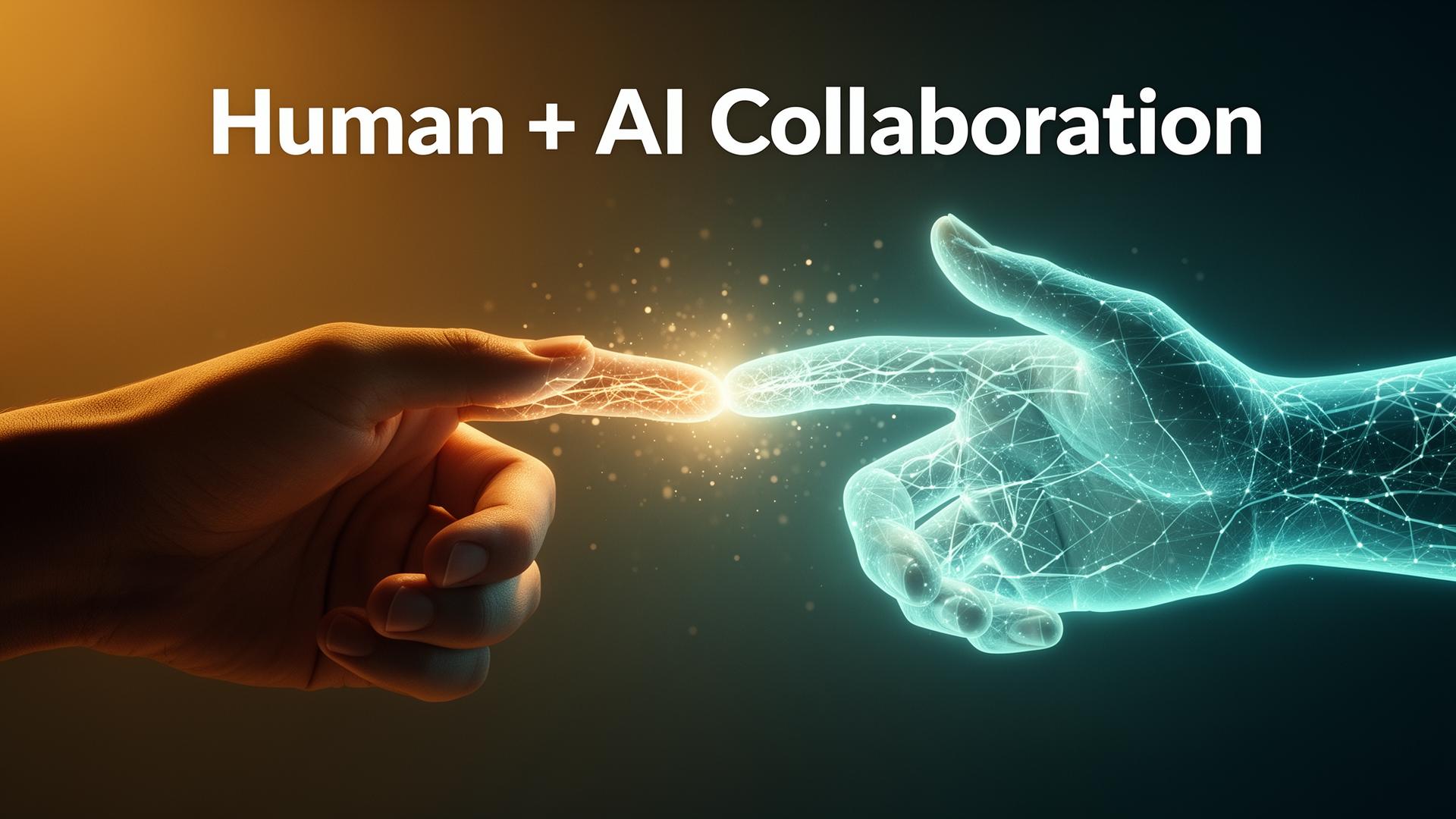
Human + AI Collaboration
The most consequential near-term impact of AI may not be replacement but augmentation - humans and AI systems working together to accelerate medicine, education, science, and creativity beyond what either could achieve alone.
Key takeaways
- AI accelerates scientific discovery by orders of magnitude in domains like protein folding and materials.
- Personalized AI tutors can dramatically improve learning outcomes when paired with skilled teachers.
- Creative work is shifting from execution to direction, taste, and curation.
- Accessibility tools powered by AI are unlocking participation for millions.
What you'll learn
How AI is becoming a cognitive collaborator across the disciplines that matter most - from drug discovery to personalized learning.
Explore the topics
Deep explainers across the field, from foundational concepts to frontier research.
AI in Medicine
Diagnostics, drug discovery, and personalized treatment.
AI for Scientific Discovery
From AlphaFold to autonomous laboratories.
AI in Education
Personalized tutors and the post-textbook classroom.
AI and Creativity
Co-creating with generative models in art, music, and writing.
AI in Knowledge Work
How AI is rewriting productivity and the white-collar economy.
AI, Robotics & Embodiment
Foundation models transferring into physical systems.
Frequently asked questions
Will AI replace human workers?
+
AI will reshape most knowledge work, automating some tasks while creating new ones. The pattern historically favors augmentation over wholesale replacement - but transitions can be painful.
Can AI really help with creativity?
+
Yes - generative models are powerful collaborators for ideation, drafting, and iteration. The most valuable creative output still relies on human taste, intent, and judgment.
Is AI safe to use in medicine?
+
AI is already deployed in radiology, pathology, and diagnostics with strong results, typically as a second opinion. Regulatory frameworks like FDA clearance govern clinical use.
Can AI tutors replace teachers?
+
Evidence suggests AI tutors complement rather than replace teachers - most effective when integrated into human-led learning environments.
How does AI accelerate science?
+
AI compresses search spaces - predicting protein structures, designing molecules, simulating experiments - letting scientists focus on hypothesis and validation.
Glossary
- Augmentation
- Using AI to enhance rather than replace human capability.
- Copilot
- AI assistant integrated into a human workflow.
- AlphaFold
- DeepMind's protein structure prediction system that revolutionized biology.
- RAG
- Retrieval-Augmented Generation - combining LLMs with external knowledge sources.
- Human-in-the-loop
- System design that keeps human judgment as the final authority.
Read full definition
Expert video: cognitively inspired machine intelligence
Fei-Fei Li argues that progress in machine intelligence is tightly coupled to what we understand about biological cognition — a premise this section returns to repeatedly. The talk is a clear statement of the human-centred framing behind current work on collaboration between people and AI systems. It gives useful context for the research and terminology used across this hub.
Fei-Fei Li
Computer scientist, Stanford University · Stanford / Wu Tsai Neurosciences Institute
Video credit: Stanford / Wu Tsai Neurosciences Institute. Embedded from YouTube; BRAINMATTER is not the publisher and adds only the editorial context above.
Work better with AI
Productivity gear and playbooks for humans working alongside AI tools. As an Amazon Associate BRAINMATTER earns from qualifying purchases at no extra cost to you.
Sponsor this work
BRAINMATTER is independent and reader-supported. Everything here stays free, ad-light, and open to everyone. A one-time sponsorship covers research time, editorial review, and hosting so we can keep publishing without paywalls.
Further reading & sources
Explore the BRAINMATTER pillars
Authoritative cornerstone hubs across human intelligence, AI, neurotechnology, and the brain economy. Each link goes to a pillar with long-form explainers, sources, and FAQs.
The Future of Human Intelligence
Flagship pillar on cognitive neuroscience, neuroplasticity, and the next 25 years of the human mind.
Human intelligence · Neuroplasticity · Brain capital
Human Intelligence & Cognitive Neuroscience
How the brain learns, remembers, reasons, and feels — from working memory to consciousness.
Cognitive neuroscience · Memory · Consciousness
Artificial Intelligence & NeuroAI
Foundation models, transformers, multimodal systems, and brain-inspired AI architectures.
AI · NeuroAI · Foundation models
Artificial General Intelligence (AGI)
Definitions, benchmarks, timelines, and the open scientific problems on the road to AGI.
AGI · Superintelligence · Scaling laws
Neurotechnology & Brain–Computer Interfaces
BCIs, neural implants, neuromodulation, and the engineering of human cognition.
Neurotechnology · BCI · Neural implants
Neurodivergence & Brain Health
Autism, ADHD, dyslexia, and the neuroscience of cognitive diversity and lifelong brain health.
Neurodivergence · Brain health · Neurodiversity
AI Ethics, Safety & Alignment
Bias, privacy, misinformation, AI safety, and governance of intelligent systems.
AI ethics · Alignment · Governance
Future of Humanity & the Brain Economy
Long-horizon scenarios for the brain economy, post-AGI society, and civilizational risk.
Brain economy · Post-AGI · Long-termism
Intelligence Index — Human vs Machine
The definitive comparison of biological and artificial cognition across substrate, scale, and reasoning.
Intelligence index · Benchmarks · Comparative cognition
Frontier AI & Neuroscience Labs
Deep profiles of the research organizations defining the next era of intelligence.
OpenAI · Anthropic · DeepMind · Neuralink
Continue exploring
Artificial Intelligence
How modern AI systems learn, reason, and generate - from neural networks to large language models.
Neurotechnology
Brain-computer interfaces, neural implants, and the convergence of biology and silicon.
Future Opportunities
Careers, industries, and innovations being unlocked by intelligence technology.