The Neuron and the Brain
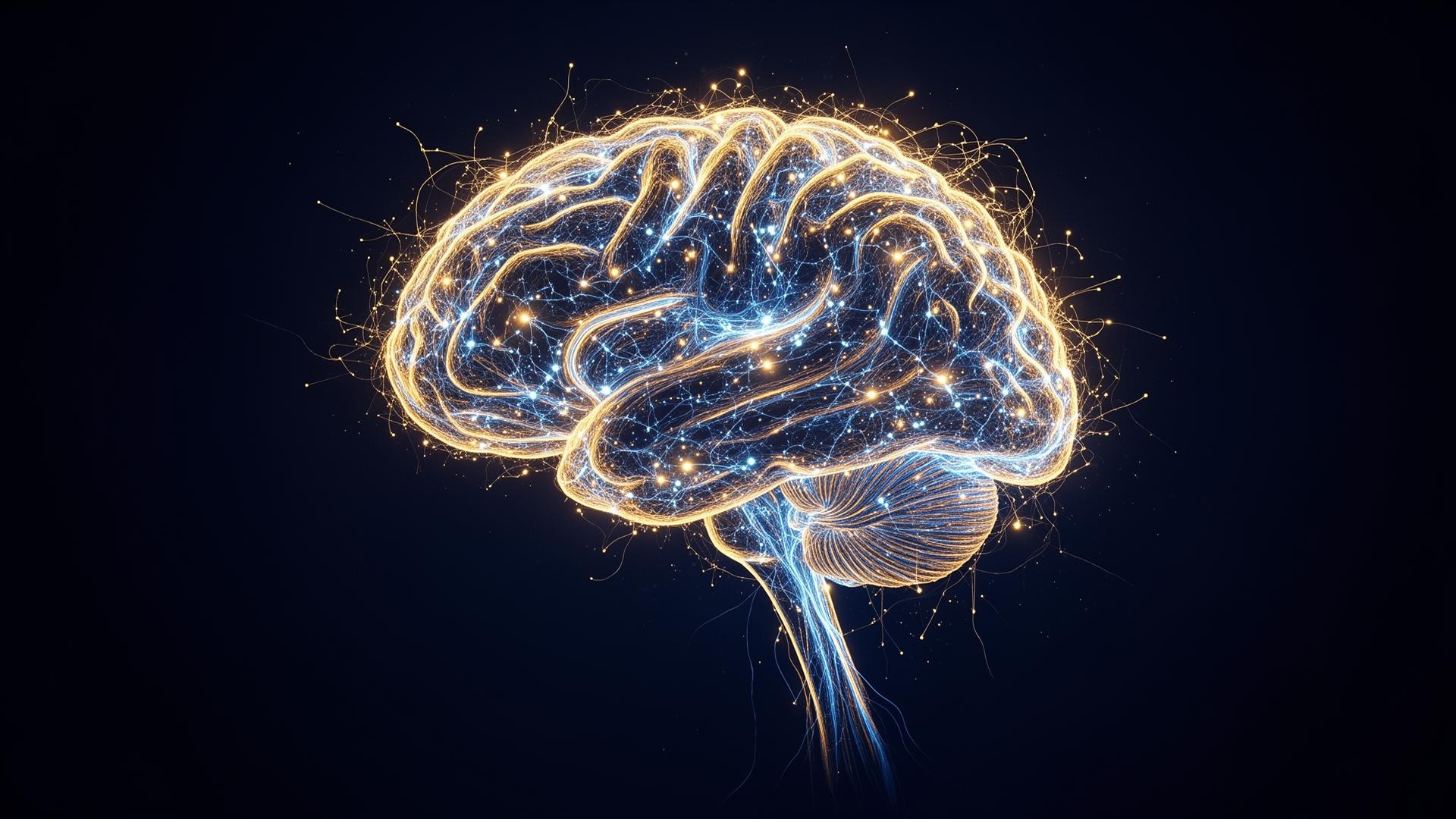
The human brain contains roughly 86 billion neurons connected by trillions of synapses, operating on a 20-watt power budget - the most sophisticated information-processing system known.
Key facts
- ~86 billion neurons, similar number of glia.
- 100–500 trillion synaptic connections.
- Operates on ~20 watts.
- Cortex has six layers and ~16 billion neurons.
The Neuron
A neuron is an electrically excitable cell that integrates inputs at its dendrites, generates action potentials at its axon hillock, and transmits signals chemically across synapses.
Neurons come in hundreds of morphological and functional types; pyramidal neurons of the cortex dominate human higher cognition.
From Neurons to Circuits
Local circuits - microcolumns, cortical columns, canonical loops - implement repeated computational motifs. The cerebral cortex contains an estimated 16 billion neurons organized into six layers.
Long-range projections link cortical regions into functional networks (default mode, salience, dorsal attention), measurable via fMRI.
Plasticity and Learning
Synaptic plasticity - long-term potentiation and depression - underlies learning at the cellular level. Structural plasticity (new synapses, axonal sprouting) continues throughout life.
Adult neurogenesis occurs in the hippocampus and olfactory bulb, though its functional role remains debated.
Energetics and Efficiency
The brain consumes ~20% of resting metabolic energy while occupying ~2% of body mass. This efficiency - roughly 20 watts for human-scale cognition - remains far beyond any artificial system.
Frequently asked
Do we use only 10% of our brain?
+
No. This is a debunked myth - neuroimaging shows nearly all brain regions are active across waking activity.
How are neurons different from transistors?
+
Neurons are analog, asynchronous, plastic, and learn from sparse experience - fundamentally unlike digital transistors.
Sources & further reading
Tools for a sharper mind
Books, journals and gear frequently cited across cognitive science reading lists. As an Amazon Associate BRAINMATTER earns from qualifying purchases at no extra cost to you.
Sponsor this work
BRAINMATTER is independent and reader-supported. Everything here stays free, ad-light, and open to everyone. A one-time sponsorship covers research time, editorial review, and hosting so we can keep publishing without paywalls.
Continue in this series
Sensory Cognition
Perception and Attention
Storage and Recall
Memory Systems
Higher Cognition
Reasoning and Decision-Making
Communication
Language and Symbolic Thought
Subjective Experience
Consciousness: The Hardest Problem
Psychometrics
Intelligence and IQ